The short answer
SBS-NC, LLC provides commercial AC repair, HVAC repair, and diagnostics for facilities in Greensboro, Winston-Salem, and High Point, NC — the Piedmont Triad — and across North Carolina, South Carolina, Georgia, Florida, Alabama, and Tennessee. A Contact us for service call pricing covers the technician visit, testing, and a written plan with pricing before any repair begins. We repair rooftop units, split systems, chillers, boilers, cooling towers, VRF systems, exhaust fans, and building controls — including equipment we didn't install. All work is self-performed by our own technicians, never subcontracted, and backed by labor and product warranties. Contract customers get 24/7 emergency dispatch. Call (336) 307-4218.
Four steps, no surprises.
You call
Tell us the site, the unit, and the symptom. We schedule — or dispatch immediately for contract customers.
We diagnose
A uniformed SBS-NC technician tests the system end to end — electrical, refrigerant, airflow, controls.
You approve
You get findings and a price in writing. Repair versus replace gets an honest recommendation, not a push.
We fix it
Repair completed, system verified under load, and the work documented for your records.
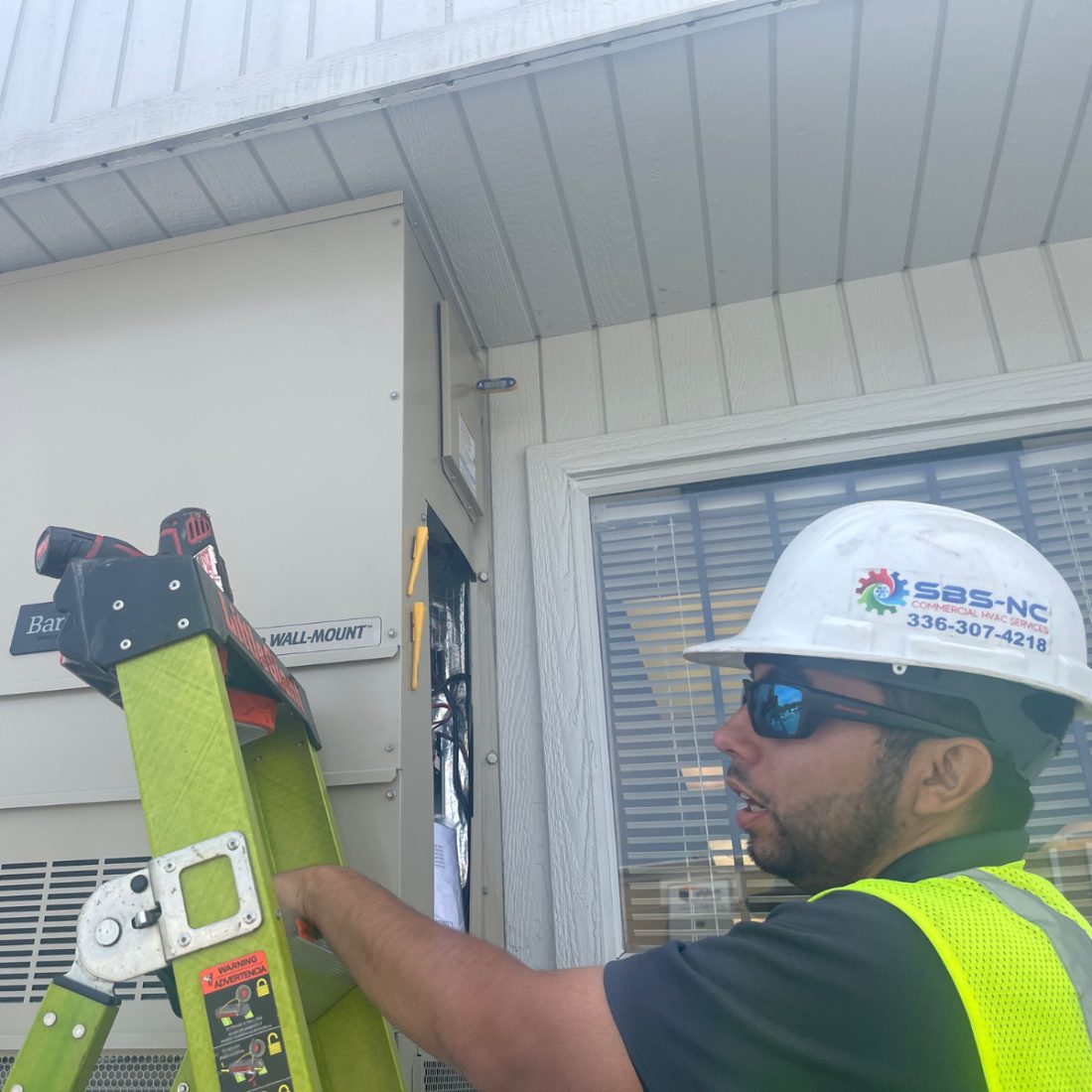
Control panel open on a wall-mount unit, meter out, cause found before anything gets replaced. This is what the trip and diagnostics visit covers — a real diagnosis, not a guess and a parts order.
The failures we see most.
Common commercial HVAC problems, and what's usually behind them.
Unit not cooling
Low refrigerant charge, a failed capacitor or contactor, a seized compressor, or a coil so dirty the system can't reject heat.
Refrigerant leaks
Located, repaired, and recharged — plus a conversation about retrofit options on older refrigerants.
Blower & fan motors
Burnt-out condenser and blower motors, bad bearings, broken belts, and unbalanced wheels replaced and verified.
Compressor failure
Diagnosed properly before replacement, because a compressor rarely dies without an underlying cause.
Electrical faults
Failed capacitors, contactors, transformers, relays, and pitted or loose connections found under load.
Control & thermostat issues
Sensors, staging, schedules, and BAS points corrected so the equipment runs the way the building needs.
Water leaks & drain backups
Clogged condensate lines, cracked pans, and failed pumps repaired before they reach the ceiling tiles.
Chillers, boilers & towers
Pumps, valves, controls, tubes, and water treatment issues on central plant equipment.
Airflow & duct problems
Hot and cold spots traced to duct leakage, closed dampers, static pressure, or an economizer stuck in the wrong position.
Commercial AC repair: the symptom, the likely cause, and what SBS-NC checks.
Most commercial AC repair calls start with one of ten symptoms. The table lists what usually sits behind each one and what our technician measures before anything is replaced, because the part that failed is often not the part that caused the failure. A capacitor that keeps dying has a motor problem; a compressor that keeps tripping has a charge, airflow, or condenser problem. Fixing the cause is what keeps the same unit off next month's call list.
The same approach covers commercial heating repair: gas heat sections in rooftop units, heat pumps, electric heat, unit heaters, and make-up air units. Boilers and chillers have their own pages: commercial boiler and cooling tower service and commercial chiller repair.

| Symptom | Likely cause | What SBS-NC checks |
|---|---|---|
| Unit runs but the air is not cold | Low refrigerant charge from a leak; failed compressor contactor or run capacitor; condenser coil too dirty to reject heat; economizer stuck open pulling in hot outside air; reversing valve stuck on a heat pump | Suction and discharge pressures, superheat and subcooling, compressor and fan amp draw, coil condition, contactor and capacitor under load, economizer position, and a leak search if the charge is low |
| Short-cycling: starts and stops every few minutes | High- or low-pressure safety tripping; dirty filter and an iced evaporator coil; failing thermostat or control board; a unit oversized for the zone | Safety-switch history and pressures at the trip, airflow and filter condition, coil temperature, control staging, and thermostat wiring |
| Breaker trips, or the unit will not start | Failed capacitor; shorted compressor or fan-motor windings; burned contactor; low voltage, loose or pitted connections | Insulation test on compressor and motor windings, capacitor microfarads, voltage drop under load, contactor contacts, and every connection torqued |
| Water on the floor or on the ceiling tiles | Clogged condensate drain or trap; cracked drain pan; failed condensate pump or float switch; a frozen coil thawing after the unit shuts off | Drain line and trap, pan, float switch and pump, then the coil temperature and airflow that caused any icing |
| Ice on the refrigerant lines or the coil | Low airflow from dirty filters, a slipping belt or a failed blower; low charge; a stuck metering device; a defrost problem on a heat pump | Filters, blower amps and belt, static pressure, charge, metering-device operation, and the defrost cycle on heat pumps |
| Grinding, squealing, rattling, or a loud hum | Worn blower or condenser-fan bearings; loose or slipping belt; failing contactor; loose panel or fan blade; compressor mechanical noise | Bearings and shafts, belt tension and alignment, fan-blade balance, contactor, panel fasteners, and compressor sound against amp draw |
| Some zones hot, some cold | Economizer or damper stuck; duct leakage or closed dampers; failed zone sensor; low airflow; a changed load the unit was never sized for | Economizer position and controls, damper actuators, static pressure, sensor readings, and supply temperature per zone |
| Energy bills up with no comfort complaint | Dirty coils; economizer stuck open or closed; heating and cooling running at the same time; schedules lost in the thermostat or building automation system; low charge | Coil condition, economizer operation, schedules and setpoints, and runtime and amps against the nameplate |
| No heat or weak heat (gas heat section) | Failed igniter or flame sensor; inducer motor or pressure switch; gas valve; limit switch tripping on low airflow; cracked heat exchanger | Ignition sequence and flame signal, inducer and pressure switch, gas pressure, temperature rise, limit switch, and a heat-exchanger inspection |
| Heat pump blowing cold in winter or stuck in defrost | Failed defrost board or sensor; reversing valve; low charge; outdoor fan motor; iced outdoor coil | Defrost cycle and sensor, reversing-valve solenoid, charge, outdoor coil and fan |
What the table cannot tell you is the price, because a capacitor and a compressor are not the same repair. Every commercial AC repair is quoted in writing after the diagnosis and before any work begins; contact us for service call pricing, and the trip and diagnostic fee is waived on covered equipment for maintenance-contract customers. Nearly every row above is also something a maintenance visit catches early; the tasks are in our commercial HVAC preventative maintenance checklist.
When it goes down after hours.
Contract customers reach a live dispatch line 24/7 and go to the front of the queue. A restaurant losing cooling on a Saturday night, a chiller tripping in a plant at 2 AM, a school with no heat Monday morning — those are the calls the program exists for.
See maintenance programsSite address and access, unit tag or location, what the equipment is doing, when it started, and any fault codes on the thermostat or BAS.
Capacitors, contactors, belts, motors, and common controls ride with our techs, so most failures are fixed on the first trip.
Labor and product warranties on the repairs we perform and the equipment we supply.
Rated 4.3 out of 5 on Google.
97 public reviews of SBS-NC, LLC on Google as of November 2026. The reviews below are quoted from that listing; read all of them, including the critical ones, at the link.
“Rick was our maintenance technician and was as thorough as they come in terms of information he reported back (along with pictures) and potential mitigation to correct anything he found.”
“Rick Johnson, who from the moment he walked thru our door, was personable, professional and a pleasure to deal with. (He knew his stuff!) Service like yours is hard to find these days.”
“I called and the next day someone showed up. Very knowledgeable and professional. I rate them A plus.”
Repairs & diagnostics FAQ.
Something down right now?
Call and we'll get a technician headed your way.