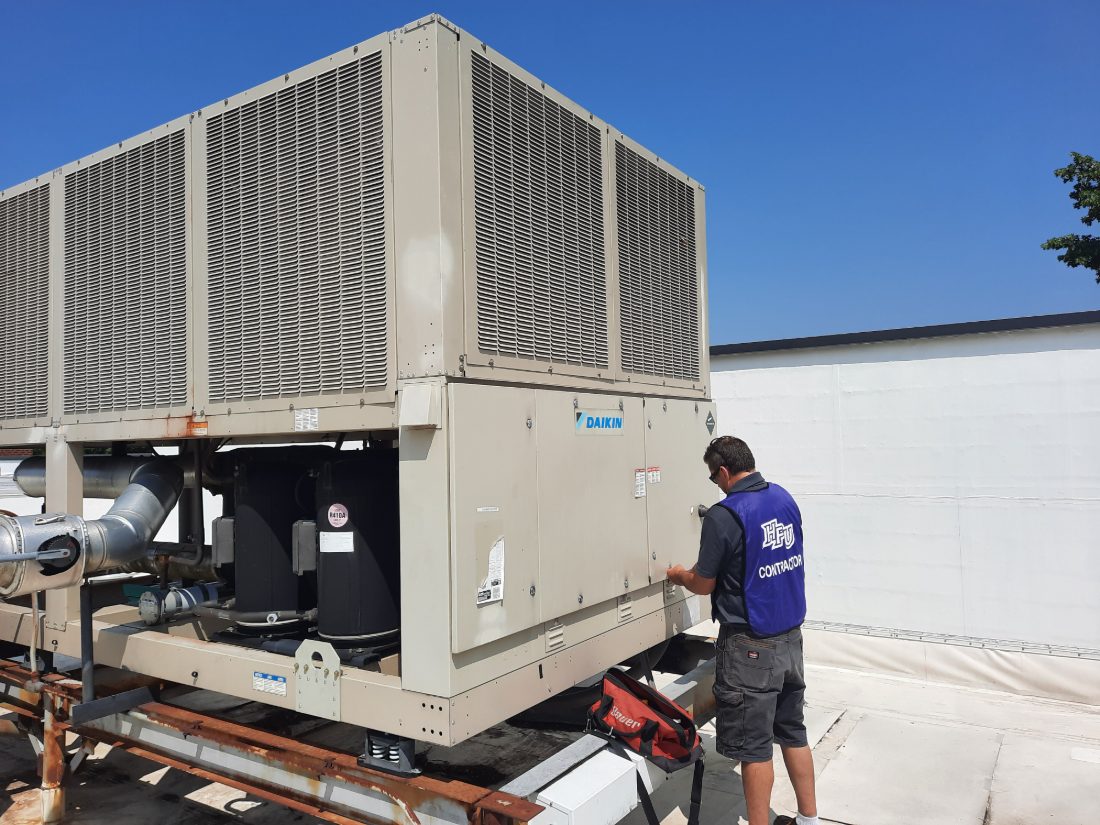
Check the simple things first
Before anyone opens a panel, look at what the building can tell you. Is the chiller getting power, and are the disconnects on? Did the chilled-water setpoint get changed? Is the building automation system showing an alarm code — and did someone silence it without writing it down? Are the chilled-water and condenser-water pumps actually running? A chiller that is locked out on a flow safety looks exactly like a dead chiller, and the fix is a pump or a clogged strainer, not the machine itself.
The failures we actually find
When it is the chiller, a handful of causes account for most no-cool calls: low refrigerant charge from a slow leak, fouled condenser tubes or dirty air-cooled coils driving head pressure into a safety trip, failed flow switches, seized or grounded compressor motors, and control or sensor faults that feed the machine bad data. On older machines, capacity control problems — slide valves, inlet vanes, unloaders — often masquerade as a refrigerant problem.
Stop resetting it
The most expensive habit in chiller ownership is clearing a safety trip repeatedly until the machine stays running. Safeties trip for a reason. A chiller that locks out on high head pressure or low oil pressure and gets reset five times in an afternoon is a chiller being driven toward a compressor failure that can cost more than some machines are worth. One reset to see if the fault was transient is reasonable. After the second trip, stop and make the call.
What the service call looks like
Our technician arrives, pulls the fault history, tests the machine, and gives you a written diagnosis with a price before any repair begins — contact us for service call pricing. Commercial chiller repairs are quoted per machine, and if the honest answer is that the chiller is at the end of its economic life, we will tell you that and price both paths.
Most of these calls are preventable
Nearly every chiller emergency we see traces back to something a maintenance visit would have caught: condenser fouling, a drifting sensor, a slow leak, a pump on its way out. If your chiller has no PM program — or a PM program that has never included eddy-current tube testing or oil analysis — that is the real problem to fix once the machine is running again.
Match the symptom to the likely cause
A chiller rarely fails without telling you something first. These are the pairings our technicians see most often. None of them is a diagnosis, but they tell you how urgent the call is and what to say when you make it.
| Symptom | Likely cause | What SBS-NC checks first |
|---|---|---|
| Will not start, no alarm, no display | Power: a tripped breaker, an open disconnect, a blown control transformer fuse, or a phase monitor holding the machine off after a utility event. | Incoming voltage and phase, control-circuit fuses, the disconnect, and the controller's power supply before anything on the refrigerant side. |
| Starts, runs a few minutes, trips on high pressure | Heat rejection: dirty or blocked condenser coils, a failed condenser fan, a cooling tower not delivering water, or non-condensables in the circuit. | Condenser coil condition and airflow, fan operation, condenser-water flow and tower condition, then head pressure and subcooling for non-condensables. |
| Runs, but chilled water never gets to setpoint | Capacity: low refrigerant charge, a compressor unloaded or failed, fouled evaporator tubes, or a load the machine was never sized for. | Superheat and subcooling, compressor amp draw and loading, evaporator approach temperature, and the actual building load against nameplate tonnage. |
| Trips on low pressure or freeze protection | Flow or charge: a chilled-water pump down, a closed valve, a clogged strainer, a stuck expansion valve, or a leak that has been slowly losing charge for months. | Chilled-water flow, pump and strainer, valve positions, then charge level and expansion-valve operation, with a leak search if the charge is low. |
| Trips on low oil pressure or oil level | Lubrication: oil migrating out with refrigerant, a failed oil pump, or liquid refrigerant flooding back to the compressor on light load. | Oil level and condition, oil pump and filter, crankcase heater, and suction superheat at light load; an oil sample if the history suggests it. |
| Flow switch or pump fault | The chiller is probably fine. Look at the pump, the VFD, the strainer, and any isolation valves that were closed for other work. | The pump and VFD, strainer differential, isolation valves, and the flow switch itself before touching the chiller. |
What a safety trip is actually telling you
Every safety on a chiller protects one specific thing. High head pressure protects the compressor from overheating and the refrigerant from over-pressurizing. Low suction and freeze protection keep the evaporator from icing and the tubes from splitting. Low oil pressure protects the bearings. The flow switch keeps the machine from running against a dead loop. When a safety trips, the machine is not broken yet. Clearing the fault and restarting it without finding the cause is how a $500 problem becomes a compressor replacement.
Most newer machines log the fault with a timestamp and the operating conditions at the moment of the trip. That history is the most valuable thing you can give a technician, so do not power-cycle the controller to clear a display if you can avoid it.
Air-cooled or water-cooled: where to look first
On an air-cooled chiller, start outside. Look at the condenser coils for cottonwood, grass clippings, or construction dust, confirm every condenser fan is turning, and check that nothing has been stored or parked where it blocks airflow. On a water-cooled chiller, start at the tower: is the tower fan running, is the basin at level, is the condenser water pump moving water, and is the water leaving the tower anywhere near design temperature? A tower that has lost its fill, its fan belt, or its makeup water will take the chiller down with it.

Have this ready when you call
- Make, model, and serial of the chiller, and the nameplate tonnage if you have it.
- The exact fault code or alarm text, and how many times it has been reset.
- When the machine last ran normally, and whether anything changed since: a power outage, a storm, work on the loop, a new tenant load.
- Chilled water setpoint, current supply and return temperatures, and whether the pumps are running.
- Whether the building can tolerate the chiller being down overnight, or whether temporary cooling needs to be discussed on the first call.
- Access details: roof hatch, mechanical room keys, lockout requirements, and who on site can meet the technician.
With that information a service manager can usually tell you on the phone whether this is a same-day dispatch, whether a part should be on the truck, and roughly what the diagnostic visit will cover.
Chiller troubleshooting questions
When the problem is the machine and not the loop, SBS-NC's commercial chiller service, repair and maintenance page covers what a repair call looks like, the maintenance tasks that prevent most of these calls, and when a chiller should be replaced instead of repaired.